
6 Phases of an Automated Guided Vehicle (AGV) Project
Thinking about automating your material flow with AGVs? A successful project starts long before the vehicles go live. Explore the 6 phases that take an AGV project from planning to operation and support.
Reading time: approx. 12 minutes
Consistent, recurring internal transport tasks are ideally suited for automation. Automated Guided Vehicle Systems (AGV) can relieve the workload on employees, who can then be deployed more effectively in other areas, while laying the foundation for enhanced efficiency and optimised processes.
With individual adaptation to your tasks and environment, simple integration into existing processes and precise navigation, an AGV system can support reliable transport, process reliability and a high level of flexibility for future layout changes.
At Jungheinrich, projects follow a tried-and-tested system structured into six phases. This ensures transparency and clarity at every step, without losing sight of the overall process and the individual challenges it poses.
The 6 Phases
1. Proposal Phase
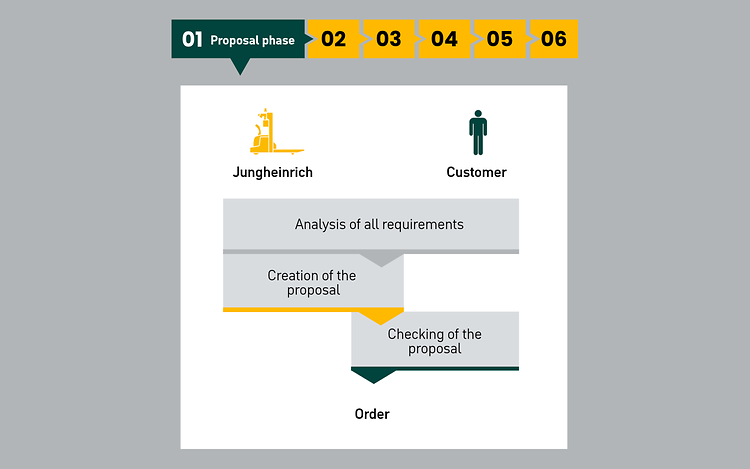
A detailed analysis of your intralogistics requirements serves as the foundation. Based on the transport matrix, the required transport volume and the condition of pick-up and drop-off points, also known as sources and destinations, are assessed. Load types, loading aids, travel routes and special considerations such as lifts, ramps or gates are also taken into account.
The IT setup is then reviewed to address data exchange, wireless network availability, warehouse management systems and interfaces with existing warehouse equipment. Based on the information collected, a comprehensive proposal is created, including suitable automated vehicle types, a tailored charging concept and the necessary peripheral equipment.
Every part of the proposal is discussed with the customer. Change requests can be incorporated before the order is placed, helping establish an optimum solution and a detailed, easily comprehensible proposal.
Your benefits in the proposal phase:
- Complete survey of your intralogistics processes
- Complete planning of your intralogistics requirements
- Accurate assessment of your IT interfaces
- Detailed, easily comprehensible proposal
- Inclusion of all change requests prior to order submission
2. Definition Phase
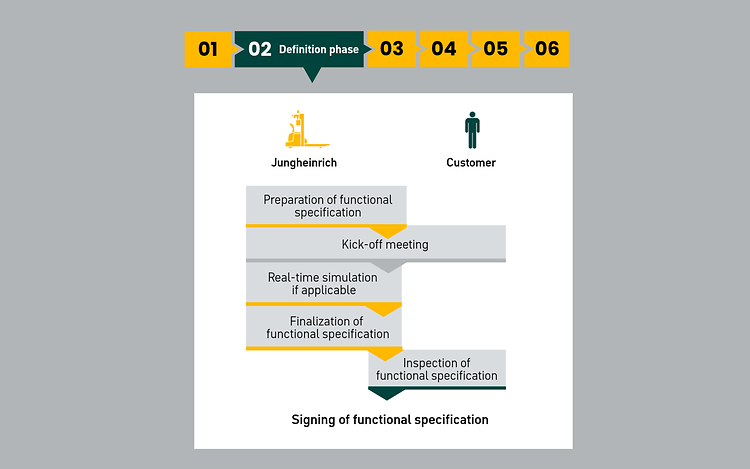
The preparation of a functional specification creates the foundation for all technical processes and the scheduling of the project. It also defines the scope of supply and services, ensuring transparency over who will deliver what and when.
Depending on the complexity of the future automated system, a real-time simulation can be included. Based on the warehouse CAD data and transport matrix, virtual travel routes, predicted traffic flow, transport performance, vehicle properties, visited stations and battery charging processes can be assessed, including borderline situations such as performance peaks.
Once all aspects have been discussed and changes incorporated, the final functional specification is reviewed during a kick-off meeting. After it has been inspected and signed, the project proceeds to preparation for implementation.
Your benefits in the definition phase:
- Clear task definition in functional specification
- Real-time simulation on request, also available separately
- Final functional specification as basis for your project
3. Preparation for Implementation
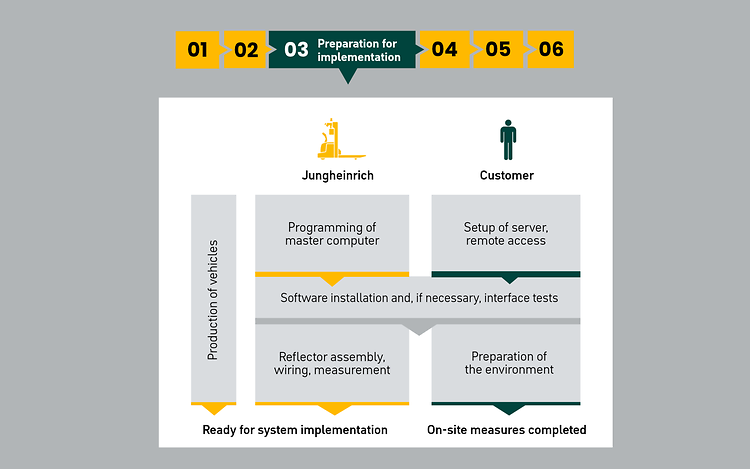
The Automated Guided Vehicles are based on tried-and-tested series production vehicles. They are constructed on the relevant production lines, equipped with the automatic kit and comprehensive safety system, and subjected to extensive testing before they are ready for use.
At the same time, the necessary programs are set up and installed. Using a virtual server within the customer’s IT landscape, the master computer and PLC interfaces are programmed, while remote access allows the function of I/O boxes controlling peripheral technology to be tested before installation.
On site, signal units, I/O boxes and reflectors for AGV laser navigation are installed. The navigation environment is measured, the network integration is completed and all interfaces are tested. As laser navigation removes the need for ground work, implementation can take place with minimal disruption to established workflows.
Your benefits during preparation for implementation:
- Your AGVs are based on tried and tested series production vehicles
- Interface tests are conducted remotely in advance to shorten the implementation time and address any problems at an early stage
- Laser navigation removes the need for ground work
- Delivery shortly before start of operation minimizes risk of damage to vehicles and potential disruption to established workflows
4. On-Site System Implementation
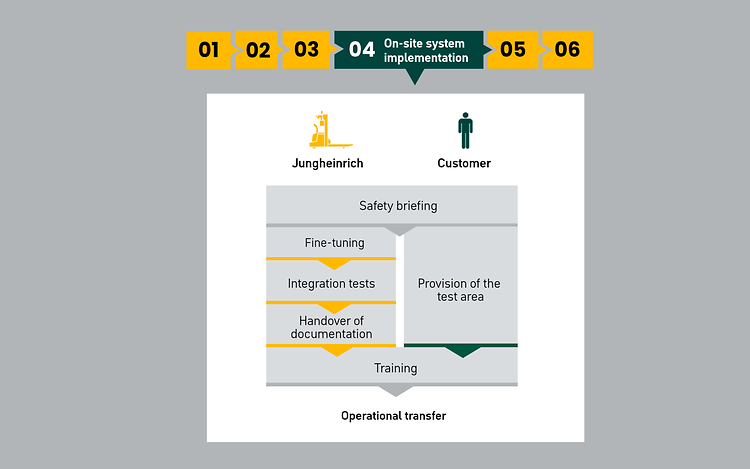
Directly after delivery, the functionality of the automated vehicles is checked in a designated test area and any necessary fine-tuning is carried out. Technicians test whether the AGVs follow the optimum routes on the programmed travel paths, record deviations and correct them in the layout program.
Integration tests are carried out with connected conveyor technology, lifts and high-speed doors. Operators and key users receive special training in troubleshooting, vehicle engagement and charging, while a safety briefing familiarises employees with the functions and safety features of AGVs in mixed operation with manual trucks and pedestrians.
Following successful fine-tuning and integration tests, the customer-specific documentation is completed and handed over. The operational system is then transferred to the customer.
Your benefits during on-site implementation:
- Individual employee training
- Safety briefing for all relevant parties to ensure smooth integration of the AGVs
- Operational reliability thanks to fine-tuning and integration tests
- Complete documentation is transparent and easy to understand
5. Commissioning Implementation
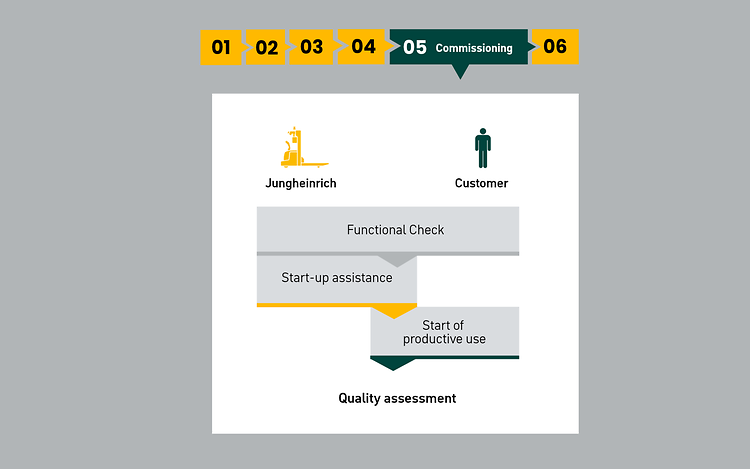
When the automated system goes live, it represents a turning point in the execution of intralogistics processes. During this phase, start-up assistance is provided to operators and relevant employees, with questions answered and problems rectified directly on site.
Through on-the-job training, employees can discover the advantages and possibilities offered by the Automated Guided Vehicles. Depending on requirements, support can be provided remotely, by an on-site service engineer or by AGV specialists. Commissioning concludes with a functional check and quality assessment of the automated system.
Your benefits during commissioning:
- On-site start-up assistance
- Seamless transition to productive operation
- Tailored level of support
6. Maintenance and Support
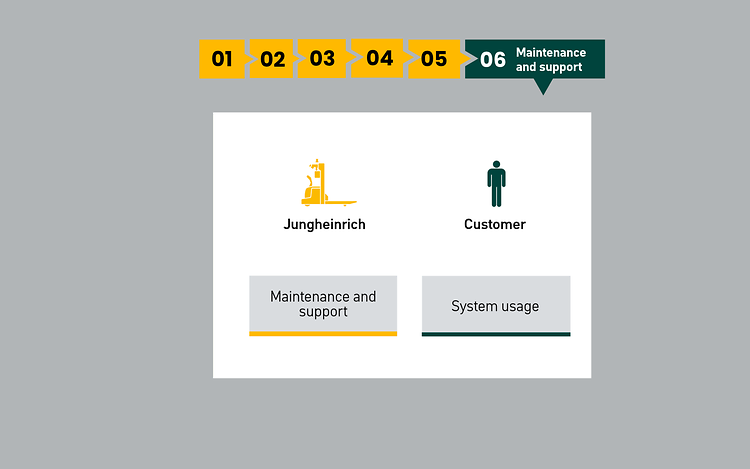
Maintenance and support continue after go-live. Preventive maintenance against failures, annual accident-prevention inspections, repairs and full-service agreements help support reliable system operation throughout its service life.
In the event of a fault or questions about using the system, experienced support staff are the first point of contact and can solve many issues directly via remote access. If this is not possible, they coordinate with a local service engineer. The support scope can be configured individually, including a 24/7 hotline and remote access.
Your service benefits:
- Extensive service network, rapid availability
- Same contacts as during implementation
- Individually configurable support scope
- 24/7 hotline and remote access possible
Why a Structured Approach Matters
Every warehouse has its own intralogistics requirements, transport matrix, IT setup and peripheral technology. A phased approach ensures that these requirements are examined clearly before productive operation begins.
It also creates transparency over responsibilities, supports the integration of hardware and software, and prepares employees through training and safety briefings. From proposal to service, the project remains focused on the overall process and the individual challenges involved.
Conclusion
A successful Automated Guided Vehicle System is developed through six clear phases: proposal, definition, preparation for implementation, on-site system implementation, commissioning, and maintenance and support. This tried-and-tested process provides transparency and clarity from the planning phase through implementation and service.
Thinking about automating consistent, recurring internal transport tasks? Jungheinrich can support you every step of the way, from the first analysis and proposal to implementation, commissioning and ongoing service.
Automation starts with the right partner and the right solution. See how Jungheinrich Automated Guided Vehicle System can help you achieve reliable transport, improved process efficiency, and smarter material flow.
Contact us now for a consultation

Speak to us if you'd like to know more!
Phone